Showing posts with label Energy. Show all posts

Solar challenge

For the Solar Challenge I created a prototype of a prototype - a data logger that records the ambient noise level (in volts) wherever it's located.

The project consists of the following elements:
  • Solar panel
  • LiIon battery (3.7V 2500mAh)
  • LiIon/LiPoly USB charger
  • Arduino Uno
  • Sparkfun microSD shield
  • 8GB microSD card
  • Various USB adapters
I am getting upwards of 8V from the solar panel in moderate sun. The entire system seems to only be drawing around 40mA. I suspect this is because the Arduino Uno draws about 40mA and the microSD shield draws a negligible amount in comparison.

Testing the panel + battery + charger 
Close-up of microSD shield 
Panel in a bag for weather protection
Action shot - on window ledge gathering sun + data
Consolidated package using found surveillance mount

Data is written to the microSD card every 200ms - a timestamp of milliseconds since startup and a reading from the electret microphone in volts. My latest test was foiled because the microSD card got wet and stopped logging shortly after startup, but I was able to get a solid chunk of real data last week and this is presented below.

Final project proposal: Sonome

Sonome (Solar-powered Noise Measurement) is the tentative name of my final project for Energy. It will be another iteration on my project for the solar challenge, but in an extremely compact, low profile, wireless form.

Tagline: Wireless, self-powered noise level analysis tool!

I want to use this module in a larger project. Having accurate (even real time) measurements of noise levels in New York or any other city is something that most people would find useful when searching for housing or even just a quiet place to relax. Unfortunately, there is no way to get this data besides putting a bunch of loggers out into the world.

Sonome would help get this going by creating an all-in-one module that could be easily deployed anywhere in the city. The main problem is getting live data. Even with a WiFi shield (which seems prohibitively expensive for mass production), the placement of the module then depends on the availability of WiFi networks in that area.

There is no GPRS shield for the TinyDuino; however, GPRS may be the only way to truly untether these modules from any sort of location restrictions.

Bill of Materials (tentative)
Component Price
Polymer Lithium Ion Battery - 400 mAh $7.95
Mini Solar Panel Module - 0.5W, 5V $2.13
TinyDuino Processor Board $20.95
TinyShield microSD $14.95
TinyShield WiFi $59.95
Total: $45.98

  • Week 7
    • Decide on components
  • Week 8
    • Order components
    • Diagram components and data flow
  • Week 9
    • Build prototype
  • Week 10
    • Test prototype
  • Week 11
    • Test prototype
  • Week 12
    • Rebuild prototype if necessary

Kinetic challenge

The kinetic challenge was a project that asked us to keep an LED lit as long as possible by storing kinetic energy. I attempted to make my own gearing for a DC motor that would generate enough electricity to not only power an LED but charge several capacitors as well.

To prove the concept I started by using a 9V battery as the power source. This made it easy to test the capacitors and experiment with different components to maximize the discharge time.


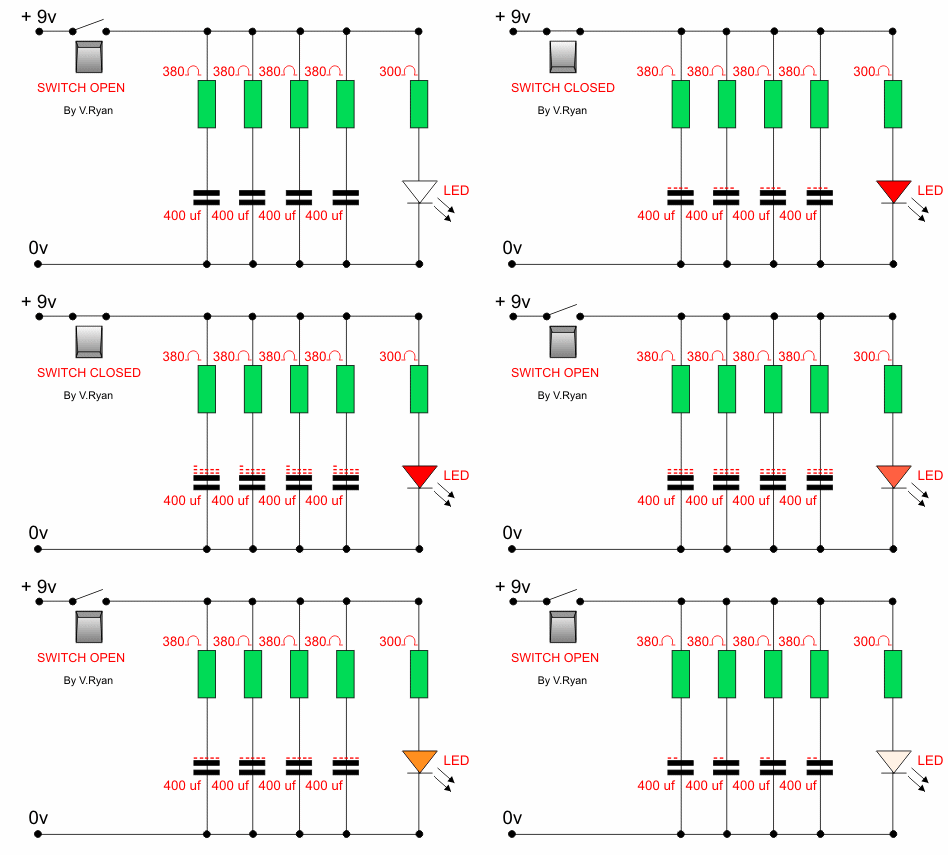
I found this schematic on technologystudent.com which suggested that a resistor in series before each capacitor would lengthen the amount of time it took for each capacitor to discharge.


I tried it out and it did improve my results, so my circuit essentially looked like the diagram, except for differing resistor values (220 Ω before each capacitor and 1 kΩ before the LED). The capacitors were 4,700 µF (4.7 mF), the largest capacitance I could find in the shop. The first photo is of the circuit without the resistors.


The last step was to create a gearing that would allow a crank to generate a sufficiently high, smooth voltage into the capacitors. I made a larger gear by hand that was meant to work with the gear that was permanently attached to the motor; however, the gear was far from perfect and I also ran into problems physically mounting the system.


In the end the system failed. I don't have a picture to illustrate this but the setup was not sufficient to power the LED, even by bypassing the capacitors. I learned that testing with ideal power sources can be both a blessing and a curse because it can cause you to overlook the fact that a large part of your system is not being sufficiently vetted for feasibility. On the other hand I now have a better grasp of how to control an electric source, which will undoubtedly come in handy in the solar challenge coming up next.

Spring 2014 courses

Always On, Always Connected (Shawn Van Every)

With their always on and always connected nature, mobile devices (phones and tablets) have become the center of our connected self. They offer us the ability to access the network anywhere at anytime, enabling us to share our experiences and share in the experiences of others. They are also starting to emerge as the hub of an emerging set of smart personal accessories such as watches, glasses and jewelry.

In this class, we'll examine the current state-of-the art in mobile technology and smart devices. We’ll focus on developing applications using the Android SDK and various accessory SDKs such as the Glass Development Kit for Google Glass (pending availability) and possibly the Pebble SDK.


Energy (Jeff Feddersen)

Energy has been called the "universal currency" (Vaclav Smil) but also "a very subtle concept… very, very difficult to get right" (Richard Feynman). Building on skills developed in physical computing, we will, through generating and measuring electricity, gain a more nuanced and quantitative understanding of energy in various forms. We will turn kinetic and solar energy into electrical energy, store that in batteries and capacitors, and use it to power small projects. Several sessions will include hands-on labs. We will develop skills useful in a variety of undertakings, from citizen science to art installations, and address a range of topics through the lens of energy. Students will build a final project using skills learned in the class.


LEDs and Non-traditional Display Surfaces (Michael Schneider)

Designing for LEDs and non-traditional display surfaces - A 2-point hands-on production based class that explores the challenges and opportunities of working with non-traditional displays. Students will learn about LED, LCD and other more architectural displays as well as look at a variety of software and content creation tools that are used to drive such displays. The class will be focused on creating a project to be presented at the LED Lab in Tribeca (website is in the process of being updated). There will be an initial quick structured project that students will use to test there content and better understand issues such as resolution, scale, speed of motion and color. Students will then develop an idea for their final project that they will develop and test out at the LED Lab 2-3 times before the final presentation/event.

The LED Lab contains a variety of different LED Products, LCD arrays, media servers, lighting implements and features the UVA designed D3 software that can build and control media displays as well as lighting in 3d.


Rest of You (Dan O'Sullivan)

We build computers around an illusory image of ourselves. In particular the illusion that our consciousness is the full extent of our experience limits how we might use computers to augment the fuller expression of our lives. This class looks at how we can use computational media to connect with the rest of your existence. The class begins by examining some of the illusions that we operate under and how revisiting those can be helpful. Then we will use sensors to give voice the less represented parts of your body. This class will also serve as a gentle rejoinder to Physical Computing and ICM. Exercises will use bio sensors, cameras, logging, mobile tech, data analysis and visualization.